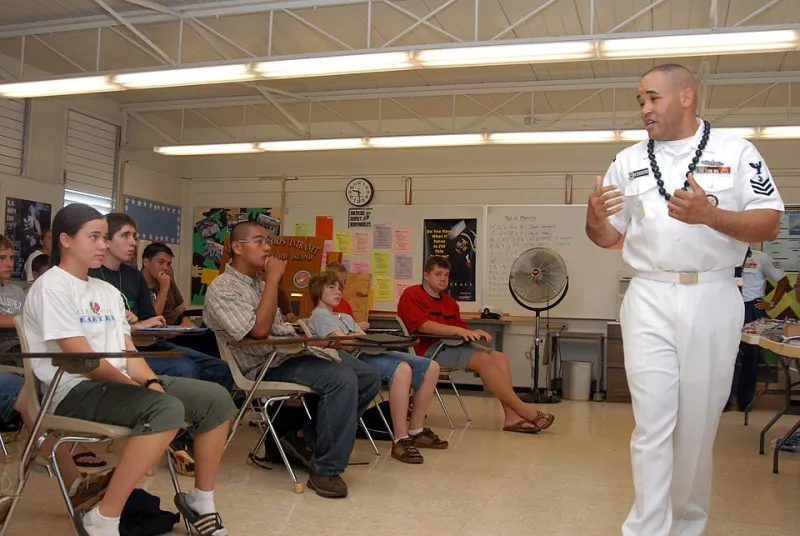
From Classroom to Career: How the Right Teacher Can Change Everything
Photo: MOIBARDE, CC BY 4.0, via Wikimedia Commons
When Marcus Ellison graduated from Santhom School nearly a decade ago, he carried with him more than a diploma. He carried the memory of a tenth-grade English teacher who stayed after class every Thursday to work through college application essays with him — not because it was required, but because she believed in what he could become. Today, Marcus is a published journalist based in Chicago. He credits that relationship, without hesitation, as the turning point in his life.
His story is not unique. Across Santhom School's alumni network, a consistent theme emerges: the teachers who made the greatest difference were not necessarily those who delivered the most polished lectures. They were the ones who saw their students as individuals — and acted on that vision.
What the Research Tells Us
The academic literature on mentorship in education is both extensive and compelling. A landmark study published by the American Educational Research Association found that students who reported having at least one strong mentoring relationship with a teacher demonstrated measurably higher rates of college enrollment, sustained employment, and career satisfaction compared to peers who lacked such connections. The effects were especially pronounced among first-generation college students and those from underrepresented communities.
Further research from the Search Institute, a Minneapolis-based nonprofit focused on youth development, identifies what it calls "developmental relationships" — connections characterized by genuine care, expanded opportunities, and honest challenge — as among the most reliable predictors of long-term resilience and success. In educational settings, teachers are uniquely positioned to provide all three.
These findings align with what Santhom School has long understood: that academic instruction and human connection are not separate endeavors. They are deeply intertwined.
Alumni Voices: When Mentorship Becomes a Turning Point
Sophia Reyes, who now leads a nonprofit focused on environmental advocacy in Austin, Texas, recalls a biology teacher at Santhom School who introduced her to field research during her junior year. "He didn't just teach us about ecosystems from a textbook," she explains. "He brought us outside, connected us with local conservation groups, and encouraged us to ask questions that didn't have easy answers. That experience shaped everything that came after."
For Daniel Park, a software engineer currently working in Seattle's technology sector, the pivotal relationship was with his high school mathematics instructor. "She had this way of making you feel like struggling with a problem was a sign of progress, not failure," he recalls. "That mindset — that difficulty is part of the process — has been more valuable in my career than any specific formula I ever learned."
These accounts reflect a broader pattern. Effective mentorship in education rarely looks like a dramatic, cinematic moment. More often, it accumulates through small, consistent acts of recognition and encouragement.
The Anatomy of an Effective Mentoring Relationship
Education researchers point to several characteristics that distinguish genuinely impactful teacher-student relationships from more transactional interactions. First and foremost is the quality of listening. Teachers who mentor effectively make time to understand a student's individual circumstances, aspirations, and anxieties — not merely their academic performance.
Equally important is what researchers call "high-expectation mentoring": the practice of holding students to rigorous standards while simultaneously communicating an unwavering belief in their capacity to meet those standards. This balance — challenge paired with confidence — is particularly powerful during adolescence, when young people are actively constructing their sense of identity and possibility.
Finally, effective mentors connect students to networks and opportunities that extend beyond the classroom. Whether that means writing a recommendation letter, facilitating an introduction to a professional in a relevant field, or simply sharing a resource that opens a new door, these acts of sponsorship can have an outsized impact on a student's trajectory.
How Santhom School Cultivates These Connections
At Santhom School, the commitment to meaningful teacher-student relationships is embedded in the institution's culture and structure. Faculty are encouraged to maintain open office hours, engage with students as whole individuals, and participate in advisory programs designed to ensure that no student navigates their academic journey without consistent adult support.
The school's advisory system, in particular, pairs each student with a dedicated faculty mentor who follows their progress across multiple years. This continuity — rare in many educational settings — allows relationships to deepen in ways that episodic interactions simply cannot replicate.
Santhom School also invests in professional development programs that equip teachers with the tools to recognize students who may be struggling in silence, and to respond with both competence and compassion.
What Parents Can Do to Support Mentoring Relationships
Parents play a meaningful role in creating the conditions under which teacher-student mentorship can flourish. Education counselors consistently recommend several practical approaches.
First, encourage your child to communicate openly with their teachers — not only when something is wrong, but as a regular practice. Students who approach teachers proactively tend to develop stronger relationships and receive more personalized guidance.
Second, attend school events and parent-teacher conferences with genuine curiosity rather than a transactional mindset. Understanding who your child's teachers are as educators and individuals can help you facilitate more meaningful conversations at home.
Third, resist the temptation to intervene in every academic challenge your child faces. Some degree of productive struggle, navigated with the support of a trusted teacher, is precisely the environment in which mentorship takes root.
Finally, affirm the importance of the relationships your child is building at school. When students hear from their parents that teachers are worthy of respect and trust, they are more likely to invest in those connections themselves.
A Legacy That Outlasts the Classroom
The most enduring measure of an education is not a GPA or a standardized test score. It is the degree to which a young person leaves school equipped — intellectually, emotionally, and professionally — to build a life of meaning and purpose.
At Santhom School, the belief is that this kind of preparation begins with people. It begins with teachers who choose, day after day, to see the potential in the students before them — and with students who are given the support and encouragement to rise to meet it.
For Marcus Ellison, Sophia Reyes, Daniel Park, and countless others, that choice made all the difference.