Why Teaching Children to Understand Their Emotions May Be the Most Important Lesson of All
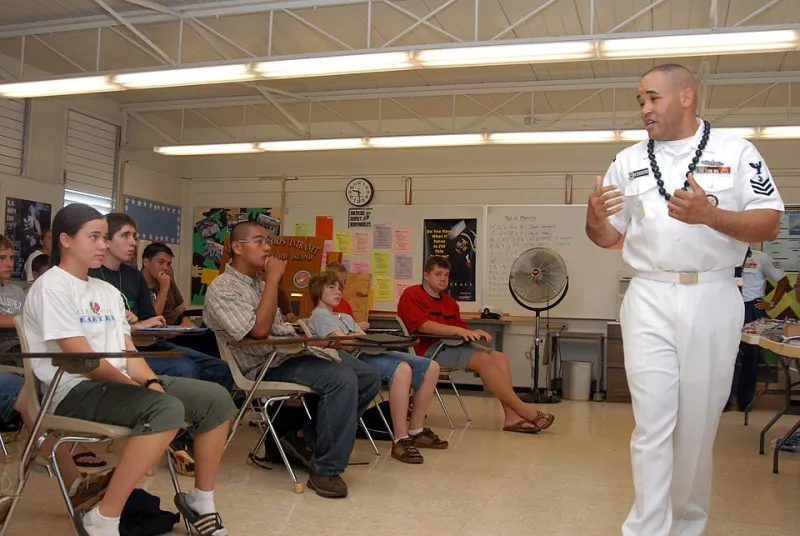
Photo: U.S. Navy photo by Mass Communication Specialist 2nd Class Michael A. Lantron, Public domain, via Wikimedia Commons
For most of the twentieth century, American schools operated under a relatively narrow conception of their purpose: teach students to read, write, calculate, and accumulate sufficient knowledge to pass examinations and gain entry to higher education or the workforce. The emotional lives of students were considered largely private matters — relevant, perhaps, to parents and counselors, but not to the core mission of schooling.
That conception is changing. And the change is long overdue.
Across the country, from urban districts in New York and Los Angeles to suburban schools in the Midwest and rural communities throughout the South, educators and administrators are grappling with a reality that can no longer be ignored: American students are struggling. Rates of anxiety, depression, and reported loneliness among young people have risen sharply over the past fifteen years. The COVID-19 pandemic accelerated trends that were already alarming. And schools — as the primary institutional spaces in which most young people spend their days — find themselves on the front lines of a genuine mental health crisis.
The response emerging from the most thoughtful educational institutions is not simply to add counselors or install crisis hotlines, though both have their place. It is to fundamentally rethink how schools cultivate the emotional and social capacities of every student — not just those in visible distress. This approach has a name: social-emotional learning, or SEL.
What Social-Emotional Learning Actually Means
SEL is a term that has gained considerable currency in educational policy conversations, sometimes generating more heat than light. Critics on the political right have occasionally characterized it as ideological overreach; critics on the left have worried that poorly implemented programs may substitute superficial "feelings talk" for genuine structural support. Both concerns deserve acknowledgment.
But at its most rigorous, SEL is neither political nor superficial. It is grounded in decades of developmental psychology and neuroscience. The Collaborative for Academic, Social, and Emotional Learning (CASEL), the leading research organization in this field, defines SEL as the process through which students acquire and apply the knowledge, skills, and attitudes necessary to develop healthy identities, manage emotions, achieve personal and collective goals, feel and show empathy for others, establish and maintain supportive relationships, and make responsible and caring decisions.
These are not peripheral concerns. They are the competencies that determine whether a young person can function effectively as a student, a colleague, a partner, a parent, and a citizen.
The Evidence Is Compelling
Opinion pieces about student well-being sometimes traffic in sentiment at the expense of rigor. This one need not. The evidence base supporting the effectiveness of high-quality SEL programming is substantial and growing.
A landmark meta-analysis published in the journal Child Development, examining data from more than 270,000 students across 213 school-based SEL programs, found that students who participated in well-designed SEL curricula demonstrated an 11-percentile-point gain in academic achievement compared to control groups. They also showed significant improvements in social skills, attitudes toward school, and reductions in conduct problems and emotional distress.
A subsequent longitudinal study tracked participants for years after their initial SEL exposure and found that the benefits persisted — and in some cases grew stronger — over time. Students who had received quality SEL instruction were more likely to graduate from high school, hold steady employment, and report higher levels of life satisfaction in adulthood.
The return on investment, by any reasonable measure, is remarkable.
The Mental Health Landscape Facing Today's Students
Understanding why SEL has gained such urgency requires confronting the mental health landscape that American students currently inhabit. The data is sobering.
The Centers for Disease Control and Prevention reported in 2023 that more than 40 percent of high school students reported persistent feelings of sadness or hopelessness in the preceding year. Nearly one in five seriously considered attempting suicide. Among teenage girls, rates of anxiety and depression have reached levels that many researchers describe as a public health emergency.
These statistics do not exist in a vacuum. They reflect the cumulative weight of social media pressures, academic stress, economic uncertainty, political polarization, and a broader cultural environment that has, for many young people, become genuinely overwhelming.
Schools cannot solve all of these problems. But they can — and must — be part of the solution. Institutions that treat student well-being as incidental to their mission are increasingly out of step with both the evidence and the moment.
How Progressive Schools Are Integrating SEL
The most effective approaches to SEL integration share several characteristics. They are systemic rather than supplemental — woven into the daily fabric of school life rather than confined to a weekly advisory period. They are relational, prioritizing the quality of connections between students and adults. And they are culturally responsive, recognizing that emotional expression and social norms vary across communities and backgrounds.
Practically, this might look like a morning check-in ritual that helps students identify and articulate their emotional state before the academic day begins. It might look like classroom discussion norms that make space for disagreement while modeling respectful dialogue. It might look like restorative practices that address conflict through conversation and accountability rather than punitive exclusion. It might look like a curriculum that includes literature, history, and social studies lessons explicitly designed to build empathy and perspective-taking.
At Santhom School, social-emotional learning is not a program layered atop an existing curriculum. It is a lens through which the entire educational experience is designed. Advisory relationships provide consistent adult support. Community norms are co-created with students. And faculty receive ongoing professional development to ensure they are equipped to recognize and respond to emotional needs with skill and sensitivity.
Balancing Rigor and Well-Being: A False Choice
One concern occasionally raised by parents and educators is that an emphasis on social-emotional development comes at the expense of academic rigor. This framing presents a false choice.
The research cited above makes clear that SEL supports academic performance rather than undermining it. Students who feel emotionally safe, who have developed the capacity to manage frustration and sustain attention, and who are embedded in supportive communities are better learners — full stop. The dichotomy between academic excellence and student well-being is a relic of an outdated educational philosophy.
Santhom School's commitment to inspiring minds and building futures is not served by choosing between intellectual development and emotional development. It is served by recognizing that these dimensions of growth are inseparable — and by designing an educational experience that honors both.
A Generation Worth Investing In
The students sitting in American classrooms today will inherit a world of extraordinary complexity and consequence. They will face challenges that we cannot fully anticipate — environmental, technological, political, and social. Whether they are equipped to meet those challenges with resilience, empathy, creativity, and moral clarity will depend, in no small part, on the quality of the education they receive now.
Teaching children to understand their emotions is not a concession to fragility. It is an investment in strength. It is, arguably, the most important lesson any school can offer — and it is one that Santhom School is committed to getting right.