Lessons Without a Lesson Plan: How Classroom Community Shapes Who Your Child Becomes
The Curriculum Nobody Writes Down
Every school year, teachers craft lesson plans, curriculum maps, and assessment frameworks designed to guide students through a defined body of knowledge. These documents are thoughtfully constructed, carefully reviewed, and aligned to academic standards. They represent the official curriculum—the intentional, visible content of a student's education.
But there is another curriculum operating simultaneously in every classroom, one that appears in no syllabus and is evaluated by no standardized test. Sociologists call it the "hidden curriculum," and its influence on students' values, identities, and life trajectories may, in many cases, exceed that of the official coursework it runs alongside.
The hidden curriculum is transmitted through the texture of daily school life: who gets called on and who doesn't, how disagreements are handled, whether differences are treated with curiosity or suspicion, how collaboration is structured, and what behaviors earn social status among peers. Students absorb these lessons continuously and largely unconsciously—and they carry them far beyond graduation.
What Children Actually Learn From Each Other
The peer environment is, for most students, the most socially intense experience of their young lives. The classroom is not merely a setting in which learning happens—it is itself a social system, complete with hierarchies, norms, alliances, and exclusions. Children navigating this system are engaged in a form of real-time social education that is extraordinarily demanding and consequential.
Research in developmental psychology consistently demonstrates that peer relationships during childhood and adolescence are among the strongest predictors of adult social competence, emotional health, and even professional success. Students who develop genuine friendships, learn to navigate conflict constructively, and experience belonging within a diverse peer community develop social and emotional capacities that are genuinely difficult to teach through formal instruction.
Conversely, students who experience chronic social exclusion, who witness or participate in persistent unkindness, or who learn that social success depends on conformity and in-group loyalty, absorb a different set of lessons—ones that can shape their relationships and self-concept for years.
The classroom community is not a neutral backdrop. It is an active educational force.
The Role of Diversity in Deeper Learning
One of the most well-supported findings in educational research is that diverse classroom communities—racially, socioeconomically, culturally, and in terms of learning profiles—produce measurable benefits for all students, not only those from historically underrepresented groups.
When students regularly engage with peers whose backgrounds, perspectives, and experiences differ from their own, they develop what researchers call "perspective-taking capacity"—the ability to genuinely consider how the world looks from a vantage point other than their own. This capacity is foundational to critical thinking, ethical reasoning, and effective collaboration in adult life.
Diversity also challenges the cognitive comfort of homogeneity. Groups composed entirely of similar-thinking individuals tend to reach consensus more quickly but make more errors. Groups that include genuinely different perspectives are slower, sometimes more uncomfortable, and significantly more accurate. Students who learn to work productively within diverse teams are developing a skill that will serve them in virtually every professional and civic context they encounter.
This is why inclusive classroom practices are not simply a matter of social justice—though they are certainly that. They are also a matter of academic and intellectual quality.
How Educators Shape the Social Climate
Teachers occupy a uniquely powerful position within the hidden curriculum. They do not merely transmit academic content—they model, through their daily behavior, a set of values and social norms that students internalize with remarkable fidelity.
A teacher who responds to a student's error with patience and intellectual curiosity teaches something about how mistakes should be treated. A teacher who consistently amplifies quiet voices and gently redirects dominant ones teaches something about equity and participation. A teacher who addresses unkindness directly and without minimizing it teaches something about the seriousness with which community norms deserve to be held.
Conversely, classrooms in which certain students are consistently marginalized, in which social hierarchies are tolerated or inadvertently reinforced, and in which belonging feels conditional, transmit their own lessons—about who matters, whose perspective counts, and what kinds of people deserve respect.
Educators who are conscious of the hidden curriculum they are transmitting—who design not only their lessons but their classroom culture with intention—become some of the most formative influences in their students' lives. This is a profound responsibility, and it is one that the best teachers carry with clarity and care.
Peer Collaboration as a Learning Model
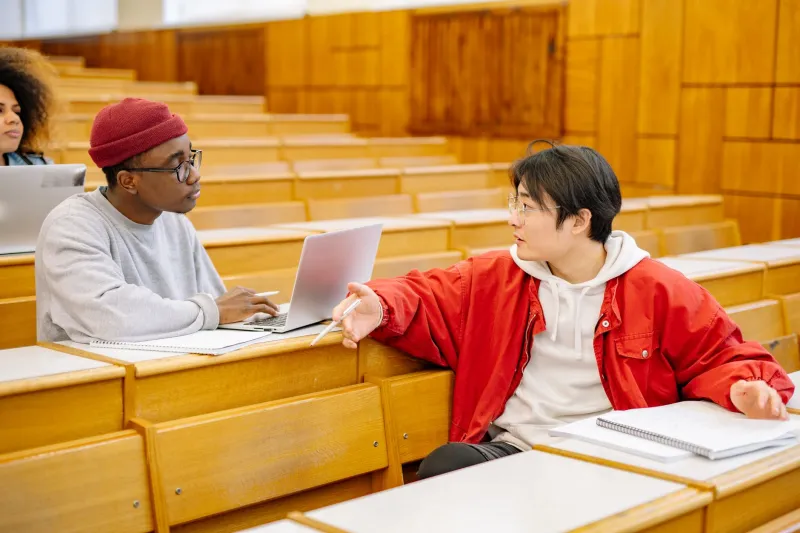
Structured peer collaboration—when designed thoughtfully—is one of the most powerful tools available for activating the hidden curriculum in a deliberately positive direction. When students work together on genuine problems, they are simultaneously practicing content knowledge and developing the relational skills that underpin it: communicating across difference, managing disagreement, distributing responsibility, and holding one another accountable with respect.
The key word is "thoughtfully." Poorly structured group work can reinforce existing hierarchies, allow dominant students to monopolize the work, and leave quieter or less socially secure students further behind. Well-designed collaborative models, by contrast, build in structures that distribute voice, rotate leadership, and require all students to contribute in visible ways.
Schools that have invested in training teachers to facilitate genuine collaborative learning—rather than simply assigning group projects—report improvements not only in academic outcomes but in classroom climate, student belonging, and the quality of peer relationships.
What This Means for Our Community
At Santhom School, we understand that the relationships students build within our community are not incidental to their education—they are a central part of it. The values students develop through their interactions with peers and teachers, the sense of identity they construct within a school community, and the social capacities they acquire through years of navigating shared space: these are outcomes we take as seriously as any academic benchmark.
This means being intentional about how classrooms are structured, how conflict is addressed, how diversity is honored, and how belonging is cultivated. It means recognizing that every choice about classroom culture—every norm established, every voice amplified or overlooked, every moment of community care or neglect—is a form of teaching.
The alumni who look back on their school years and describe experiences that shaped who they became are rarely describing a particular exam or a specific chapter in a textbook. They are describing a teacher who believed in them, a peer group that challenged and supported them, a community that made them feel they belonged.
That is the hidden curriculum at its best. And it is, ultimately, what schools are for.